Most skis don't get ruined on the mountain. They get ruined in the garage. A pair of skis that went into storage in April with wet edges and a thin wax layer comes out in November with rust, dried-out bases and a tune that has to work twice as hard to get back to where it started.
Late October and early November are the right window to fix that, before the first storm fills I-70 and every tuning bench in the state gets busy. At Maison de Ski in Idaho Springs, we've been tuning gear since 1970, and the pre-season rush looks the same every year: a pile of skis that were ridden hard last winter and then forgotten. Here's a simple checklist you can run at home, and what to ask for when you drop them off.
What storage does to a ski
Skis left in a hot garage or a damp basement lose their wax to evaporation and their edges to moisture. The steel oxidizes, the base dries and turns chalky, and any small scratch from last March can lift a little P-Tex and let water into the core. None of that is dramatic. It just means the ski that felt smooth in February feels slow and grabby in December.
The fix is usually simple. A tune cleans the base, sharpens the edges, seals small damage and puts wax back on. Doing it in the fall means you find the problems while there's time to fix them, instead of discovering a core shot at the bottom of the first run.
Check the base first
Turn the ski over and look at it under good light. You are looking for three things: white, chalky patches where the base has dried out, deep scratches you can catch with a fingernail, and any spot where you can see through to the core. A base that is merely dry needs wax. A base with gouges needs P-Tex fill before wax, which is part of a full tune.
Run your hand along the base from tip to tail. It should feel smooth and slightly waxy, not rough or dry. Any spot that grabs at your skin is worth pointing out when you drop the skis off. A base that has been sitting all summer often feels like a dry sponge, and it will soak up wax unevenly until it has been cleaned.
Base inspection checklist
- Chalky white patches mean the base is dry and needs wax
- Scratches you can feel with a fingernail need P-Tex
- A visible core shot is a repair, not a wax job
- Rust along the edge means moisture sat on the steel all summer
- Bases that look grey rather than black usually need a stone grind
Look at the edges
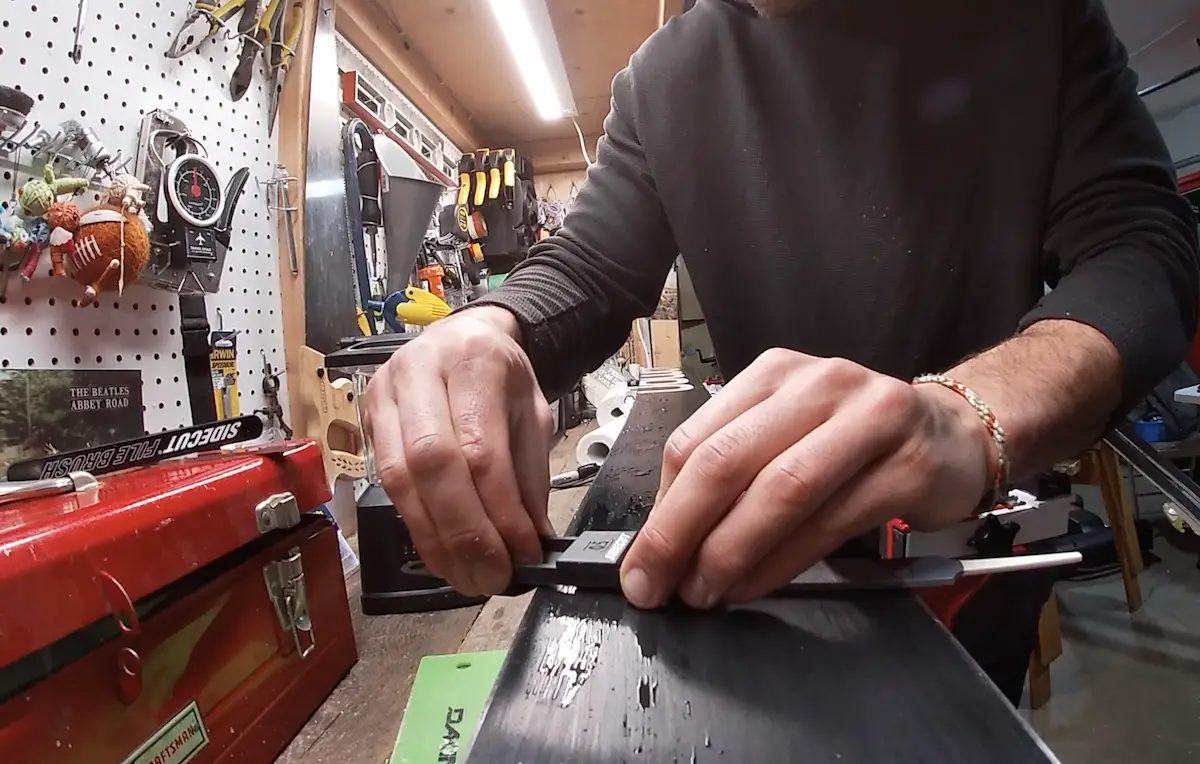
Run a thumb lightly along the edge, carefully, across the edge rather than along it. A smooth edge that grabs your skin is sharp. A rounded, shiny edge that slides is dull. Rust spots are common after a summer in storage, and light surface rust comes off with a sharpen. Deep pitting is a different story: if the steel has been eaten away, a tune can only do so much.
Check the whole length, not just the middle. Edges wear unevenly, especially near the tip and tail where skis take the most abuse in the lift line and the parking lot. A ski can feel sharp in the middle and still be rounded where it matters most in a turn. Run your thumb from tip to tail and notice where the grip changes.
If the edges are badly rusted, don't try to sand them at home. A shop sharpen removes the rust evenly and resets the angle along the whole edge, which is hard to do by hand without rounding it off. Light surface rust is easy. Pitting that you can feel with a fingernail is a job for the bench.
Renting gear for this trip?
Maison de Ski fits skis, snowboards and snowshoes at I-70 Exit 241 in Idaho Springs, 25 miles from Loveland and on the way to every major I-70 resort. Early pickup is free after 2 PM the day before.
The wax you lost
Wax is a wear layer, not a permanent coating. It rubs off on snow, on the car rack, on the garage floor. By the end of a season most skis are running on bare base, which is why they feel sticky in wet snow and slow in cold snow. A hot wax puts that layer back.
Wax also protects the base. A dry base oxidizes and turns grey, and it takes on scratches more easily because there is no slick layer to shed dirt and ice. Our quick hot wax is free with any rental, and a hot iron wax on your own skis is $15.
Choosing the right tune
Not every ski needs the full treatment. If your skis were tuned at the end of last season and stored dry, a quick tune at $30 may be all they need. If they went away dirty or have visible damage, a mid-level tune at $45 adds a belt sand, and a full tune at $65 adds P-Tex fill and a stone grind.
If you're not sure, bring them in. We'll look at the base and edges and tell you honestly which job fits, rather than selling you the biggest one on the menu. A ski in good shape doesn't need a stone grind just because it's October.
Tune options at Maison de Ski
- Quick Tune $30: edge sharpen and hot wax
- Mid-Level Tune $45: belt sand, edge sharpen, hot wax
- Full Tune $65: P-Tex fill, belt sand, edge sharpen, stone grind, hot wax
- Hot Iron Wax $15, or a quick hot wax for free
- Binding Adjust & Function Test $20, required after any adjustment
Book it before the first powder day
The first big storm on I-70 does two things at once: it brings everyone to the mountains and it fills every tuning bench in the corridor. The week before Thanksgiving is usually calm. The Saturday after the first footer is not.
Drop your skis off on a weekday morning, or plan on the expedited service: drop off before 10:00 AM and we guarantee it by 5:00 PM for an extra $20. Either way, you start the season on gear that's ready instead of gear that's been sitting since March.
Common questions
When should I get my skis tuned before ski season?
Late October through mid-November is the best window in Colorado, before the first big storm brings crowds to the tuning bench. If you stored your skis dry and already tuned, a quick tune is enough. If they sat dirty or damp all summer, get them in earlier so there is time for P-Tex work and a stone grind.
Can I ski on last season's wax?
You can, but it will feel slow and grabby, especially in wet snow. Wax wears off during a season and evaporates in storage, so most skis come out of summer with a dry base. A hot iron wax costs $15 at Maison de Ski, and a quick hot wax is free.
Do I need a full tune every year?
No. A full tune at $65 is for skis with base damage, core shots or a base that needs a stone grind. Skis in good shape often just need a quick tune at $30 for a sharpened edge and fresh wax. We'll look at your skis and recommend the smaller job when it is the right one.